What service-oriented architecture actually means
Service-Oriented Architecture (SOA) is a way of designing software so that distinct business capabilities, such as user authentication, payment processing, or credit checking, are each built as self-contained, reusable services. Those services communicate over a network using standardised protocols, most commonly SOAP or HTTP, rather than being wired together inside a single monolithic codebase.
The concept was first described in April 1996 by researchers at the Gartner Group, making it one of the older formal architectural patterns in enterprise software. The core idea has remained consistent: instead of duplicating logic across applications, you expose it once as a service that any authorised consumer can call. This is what separates SOA from simply splitting code into modules. The services are independently deployed, independently maintained, and reachable over a network.
Understanding SOA is foundational to software architecture more broadly, because many of the patterns it introduced, service contracts, registries, and loose coupling, are still central to how distributed systems are designed today.
The core principles that define how SOA works
SOA is built on a set of design principles that govern how services are built and how they interact.
Standardised service contracts define what a service does and how to call it, enabling interoperability between different systems and vendors. Loose coupling means each service minimises dependencies on others, so a failure in one service does not cascade into the applications consuming it. Together these two principles are what make large-scale enterprise integration practical.
Beyond those, service abstraction hides internal logic behind a clean interface, so consumers never need to know how a service performs its task. Reusability is the direct payoff: a service built once for one application can be consumed by many others without rebuilding the underlying logic. Interoperability extends this further, allowing services built on different vendor platforms to work together because they share standardised communication contracts.
These principles did not disappear when newer patterns arrived. They are the direct ancestors of the API contracts, service meshes, and registry patterns used in microservices architectures today.
SOAP, REST, and how services actually communicate
SOA was initially implemented using the SOAP protocol, which pairs with a WSDL (Web Service Definition Language) document that formally describes the service's interface. SOAP is XML-based and supports HTTP, FTP, and SMTP, making it versatile for enterprise environments. Its built-in standards for transactional auditing still make it the preferred choice in industries like financial services, where compliance requirements demand a formal, auditable message contract.
Over time, RESTful HTTP with JSON largely replaced SOAP for new development. REST is lighter, easier to consume from web and mobile clients, and maps naturally onto modern API-first design. Today, SOAP is almost entirely confined to legacy platforms, while new distributed systems default to REST or, increasingly, gRPC and event-driven messaging.
Both approaches are valid SOA implementations. The choice between them is mostly a question of what the consuming systems expect and what governance requirements exist, not a question of architectural correctness.
Service registries and governance at enterprise scale
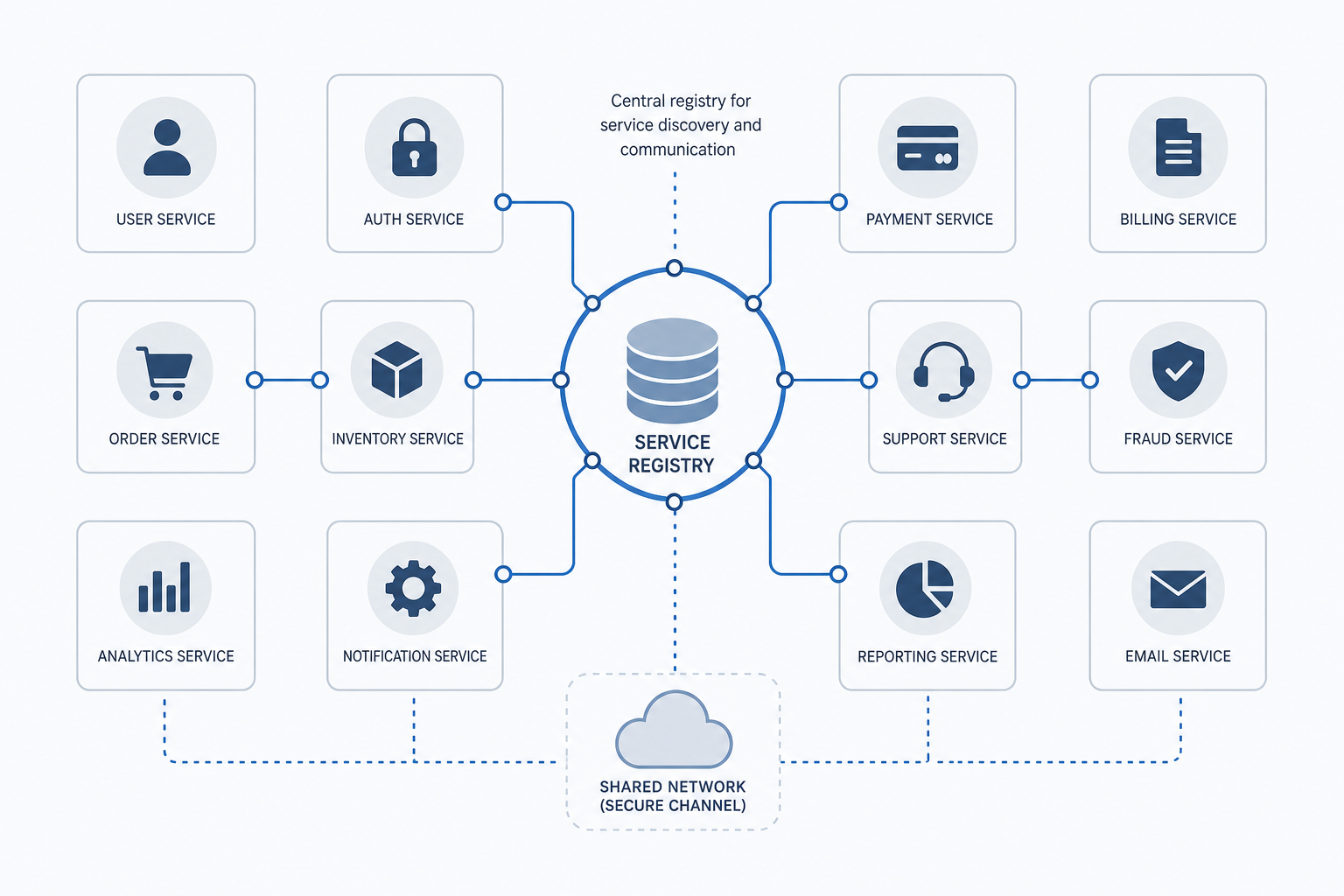
One of the practical challenges SOA introduces is keeping track of what services exist and how to reach them. A service registry solves this by cataloguing every available service along with metadata about its interface, location, and dependencies. Consumers can discover and invoke services at runtime rather than having their locations hardcoded, and administrators can manage the full service inventory from a central point.
Governance is the harder problem. Service governance controls the full lifecycle of a service, from development through publication in the registry to eventual retirement. Without it, organisations accumulate overlapping services, undocumented dependencies, and no clear ownership, which is one of the most common failure modes in large SOA deployments.
This is also where SOA projects most often stall. The technology is rarely the bottleneck. Establishing clear ownership, versioning policies, and deprecation processes requires organisational discipline that the architecture itself cannot enforce. Engaging experienced IT consulting support during the governance design phase tends to prevent the most costly mistakes.
How SOA relates to microservices and modern alternatives
Microservices are often described as the natural evolution of SOA, and in many ways that is accurate. Both approaches decompose systems into independently deployable services. The differences are mostly about granularity and tooling. Microservices draw finer boundaries around individual functions, favour lightweight protocols, and are typically packaged in containers managed by orchestration platforms like Kubernetes.
SOA, by contrast, tends toward larger service boundaries and relies on an Enterprise Service Bus (ESB) for routing and transformation, which can become a bottleneck and a single point of failure. Microservices distribute that coordination logic across the services themselves and the infrastructure layer.
Neither is universally better. Organisations with large, stable enterprise systems and heavy compliance requirements may still find SOA's formal contracts and centralised governance appropriate. Organisations building new products or modernising legacy platforms typically get more flexibility from a microservices approach, especially when paired with containerisation and CI/CD pipelines.