Software architecture explained: principles, patterns, and how to apply them

    What Is Software Architecture? Principles, Patterns & Best Practices

    Software architecture explained: principles, patterns, and how to apply them

    Understand the structural decisions that determine whether a system scales, stays secure, and remains maintainable over time.

    Build software systems on a solid architectural foundation

    Explore how Techfirst designs and staffs architecture for modern software systems built to last.

    What software architecture actually defines

    Software architecture is, at its core, the high-level structural design of a system. The ISO/IEC/IEEE standard defines it as "the fundamental organisation of a system embodied in its components, their relationships to each other, and to the environment, and the principles guiding its design and evolution." In practical terms, it determines how modules are divided, how they communicate, and how the whole system meets both functional requirements (what it does) and non-functional requirements (how well it does it: scalability, security, maintainability, performance). Architecture is not the same as design in the narrow sense. It operates at a level above individual classes or functions, setting the boundaries within which all detailed design decisions are made. Think of it as the blueprint that the development team builds upon. Getting it right early reduces costly rework later.

    The principles that guide every sound architecture

    Several principles recur across every credible approach to software architecture, and they reinforce one another. Separation of concerns is the most fundamental: dividing a system into distinct parts, each with a clear, bounded responsibility. This is the basis of modularity, and it directly enables loose coupling (components depend on each other as little as possible) and high cohesion (what belongs together stays together). Together, these three properties make systems easier to test, extend, and replace piece by piece.

    The SOLID principles are an industry-standard framework that operationalises these ideas at the code level. Two of the five SOLID principles, Single Responsibility and Interface Segregation, are direct derivations of separation of concerns. Beyond SOLID, good architecture also means planning for change: building well-defined interfaces between components so that one part can evolve without breaking others. Architecture decisions should be explicit and documented, not implicit and tribal.

    The five patterns most teams encounter in practice

    No single pattern fits every problem. The most widely used ones each represent a different set of tradeoffs.

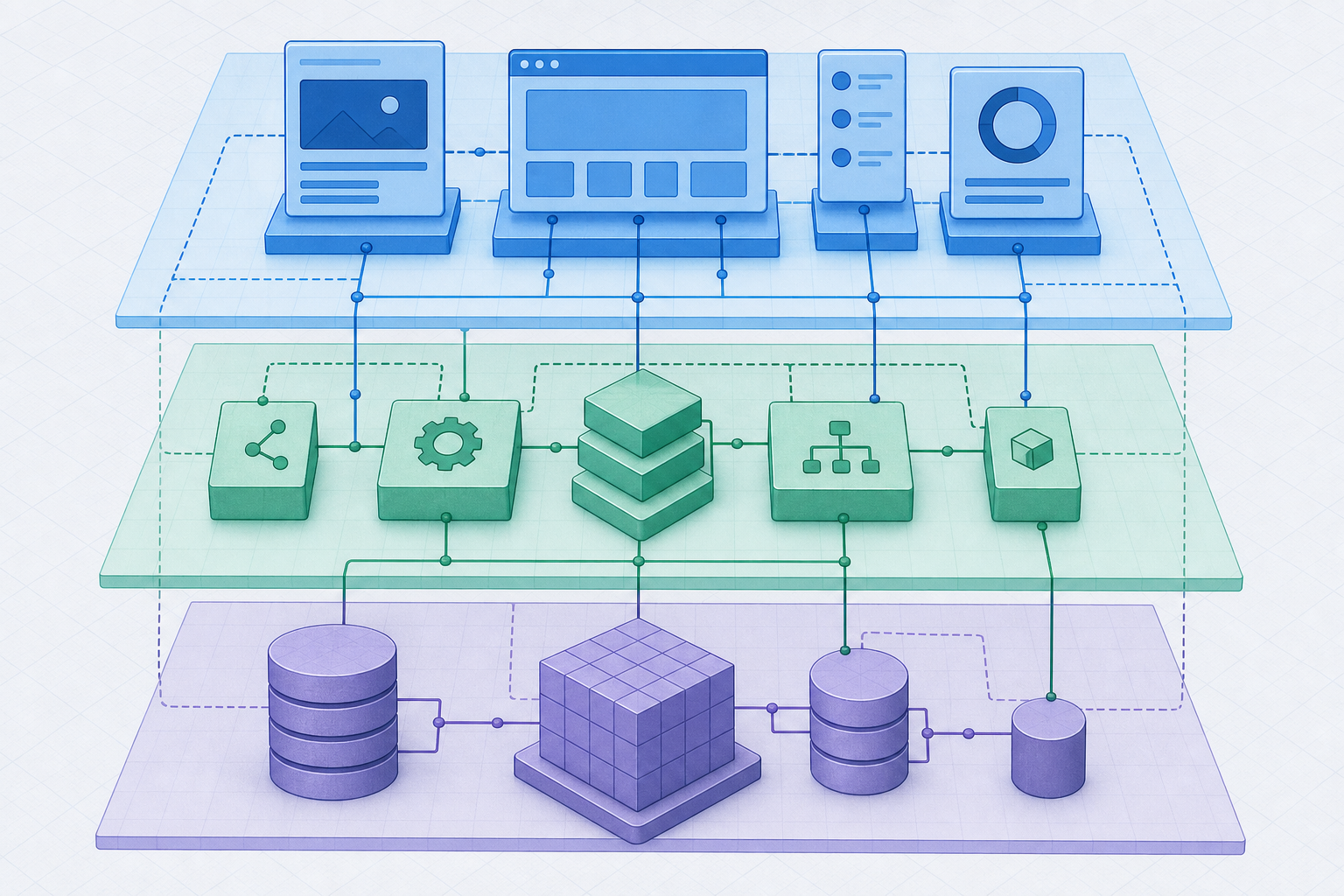
    Layered (n-tier) architecture divides an application into single-purpose layers, typically presentation, business logic, and data access. Each layer uses services from the layer below it, but is unaware of layers above. It is one of the most common patterns in the industry precisely because it is straightforward to develop and maintain.

    Microservices structures the application as a set of independently deployable, loosely coupled services, each managing its own domain. Services communicate over well-defined APIs and are often containerised using technologies such as Docker. This promotes scalability and fault isolation, but adds operational complexity.

    Event-driven architecture centres on the production, detection, and consumption of events, allowing components to react asynchronously. It suits systems that need high responsiveness and loose coupling between producers and consumers.

    Monolithic architecture packages all business logic into a single deployable unit. Simpler to start with, but harder to scale or change independently as the system grows.

    Client-server separates the system into clients that request services and servers that provide them, a foundational model underlying most web applications.

    Matching a pattern to the actual project context

    Choosing an architectural pattern is not a theoretical exercise. It depends on team size, deployment environment, expected load, and how the system is likely to evolve. A small team building an internal tool may be better served by a well-structured monolith than by a microservices setup that demands container orchestration, service discovery, and distributed tracing from day one.

    Conversely, a platform expected to scale across multiple independent product domains, with separate teams owning each, is a natural fit for microservices. There is no universally correct answer: every pattern has tradeoffs, and the right choice requires weighing them against the specific constraints of the project. This is why architecture decisions should be made deliberately and documented, so the reasoning behind them can be revisited as context changes.

    How architecture connects to long-term system health

    A system's architecture shapes its trajectory long after the initial build. Systems with clear separation of concerns and well-defined interfaces are far easier to extend, test, and hand off to new teams. Those built without architectural discipline tend to accumulate tight coupling and unclear boundaries, making every change expensive and risky.

    Legacy modernisation projects, migrating a monolith to microservices or moving on-premises infrastructure to cloud, almost always begin with an architectural assessment. The goal is to understand what the current structure actually is (often different from what documentation claims), identify where coupling is highest, and plan a migration path that preserves business continuity. For teams working with Kubernetes orchestration, architectural decisions about service boundaries, deployment units, and inter-service communication directly determine how well the cluster can be managed and scaled in production.

    The structural decisions made early in a project shape every line of code written after them, for better or worse.

    How to approach software architecture design step by step

    1. 1

      Identify functional and non-functional requirements

      Before drawing any component diagram, establish what the system must do and how well it must do it. Non-functional requirements, such as expected load, latency targets, security constraints, and uptime needs, are often what actually determine which architectural patterns are viable. Skipping this step leads to architectures that work in demos but fail under real conditions.

    2. 2

      Define system boundaries and major components

      Divide the problem domain into distinct areas of responsibility. Each major component should have a single, clear purpose and a defined interface through which other components interact with it. This is where separation of concerns moves from principle to practice. Avoid the temptation to group things by technical layer alone; group by business capability where it makes sense.

    3. 3

      Select an architectural pattern that fits the context

      Evaluate the candidate patterns against your requirements and constraints. A layered architecture is a reasonable default for many business applications. Microservices make sense when independent scalability and team autonomy are genuine needs, not aspirations. Document the reasoning behind the choice, including which alternatives were considered and why they were ruled out. This record is valuable when the context changes.

    4. 4

      Apply core principles to the detailed design

      With the pattern chosen, apply loose coupling, high cohesion, and the SOLID principles to the detailed component and interface design. Define clear contracts between components. Where services communicate over a network, agree on API contracts early and treat them as stable boundaries. For teams using Kubernetes orchestration, this is also the stage to decide on deployment units and service mesh configuration.

    5. 5

      Validate the architecture against quality goals

      Test the architecture before committing to it fully. This can mean building a small proof-of-concept for the riskiest component, running load tests on a prototype, or conducting an architecture review with senior engineers. Architectural decisions are expensive to reverse, so early validation pays for itself many times over. Identify the assumptions the architecture rests on and check them explicitly.

    6. 6

      Document decisions and plan for evolution

      Record the key architectural decisions, the context they were made in, and the tradeoffs accepted. As the system grows, revisit these decisions periodically. Good architecture is not static: it evolves as requirements change, as the team grows, and as the operational environment shifts. A documented architecture is one that can be understood, challenged, and improved by people who were not in the room when it was first designed.

    Benefits

    Systems that scale without full rewrites

    Architectural patterns like microservices enable independent scalability: individual services can be scaled to meet demand without touching the rest of the system, avoiding the costly rewrites that tightly coupled monoliths eventually require.

    Reduced cost of change over time

    Loose coupling and well-defined interfaces mean that changing one component does not cascade into changes across the whole system. The cost of each change stays bounded, which matters enormously as systems grow and teams turn over.

    Fault isolation and system resilience

    In a microservices or event-driven architecture, a failure in one service does not automatically bring down the entire system. Fault isolation is a structural property, not something you add later, and it depends entirely on how well the architecture separates concerns.

    Faster onboarding for new team members

    A system with clear architectural boundaries and documented decisions is far easier for new engineers to understand. Explicit component responsibilities reduce the time it takes to become productive and lower the risk of accidental breakage.

    A foundation for security and compliance

    Security controls are easier to apply consistently when the architecture defines clear boundaries between layers and services. Access control, data validation, and audit logging can be enforced at well-defined interfaces rather than scattered throughout the codebase.

    Architecture decisions in real project contexts

    Retail platform migrating from monolith to microservices

    A retail company running a decade-old monolithic e-commerce platform finds that deploying a change to the checkout flow requires re-testing and redeploying the entire application. The team decides to migrate to a microservices architecture, starting by extracting the product catalogue and order management into independently deployable services. Each service is containerised and communicates with others over well-defined APIs. The migration is phased, keeping the monolith running while new services are carved out, which preserves business continuity throughout the transition.

    Healthcare provider modernising a legacy integration layer

    A healthcare organisation has a core patient management system connected to a dozen other systems through point-to-point integrations built over many years. The result is a tightly coupled web where changing one system risks breaking several others. An architectural review identifies the lack of separation of concerns as the root cause. The solution is to introduce an event-driven integration layer: systems publish events to a central bus, and consumers subscribe to what they need. Loose coupling replaces brittle direct connections, making each system independently maintainable.

    Startup choosing between monolith and microservices

    An early-stage software company is designing its first product and faces the classic question: monolith or microservices? With a team of a few engineers and an evolving product definition, the operational overhead of microservices, service discovery, distributed tracing, and container orchestration, outweighs the benefits at this stage. A well-structured layered monolith with clear internal boundaries is chosen deliberately, with the understanding that specific components can be extracted into services later if independent scaling becomes a genuine requirement.

    Automotive manufacturer rebuilding a web platform with clear layers

    An automotive manufacturer rebuilding its customer-facing web platform chooses a layered n-tier architecture to separate the presentation layer, business logic, and data access clearly. This allows front-end teams and back-end teams to work in parallel with minimal coordination overhead. The data access layer is designed with well-defined interfaces so that the underlying database can be optimised or replaced without touching business logic. Separation of concerns at the architectural level directly reduces inter-team friction and accelerates delivery.

    Common questions about software architecture

    Get architecture that fits your system and your team

    If you are designing a new system or reassessing an existing one, the architectural decisions you make now will shape every build, deployment, and change that follows. Techfirst provides both system architects and developers who can assess your current structure, recommend the right pattern for your context, and execute the build or migration end to end.