Two layers that every Kubernetes cluster shares
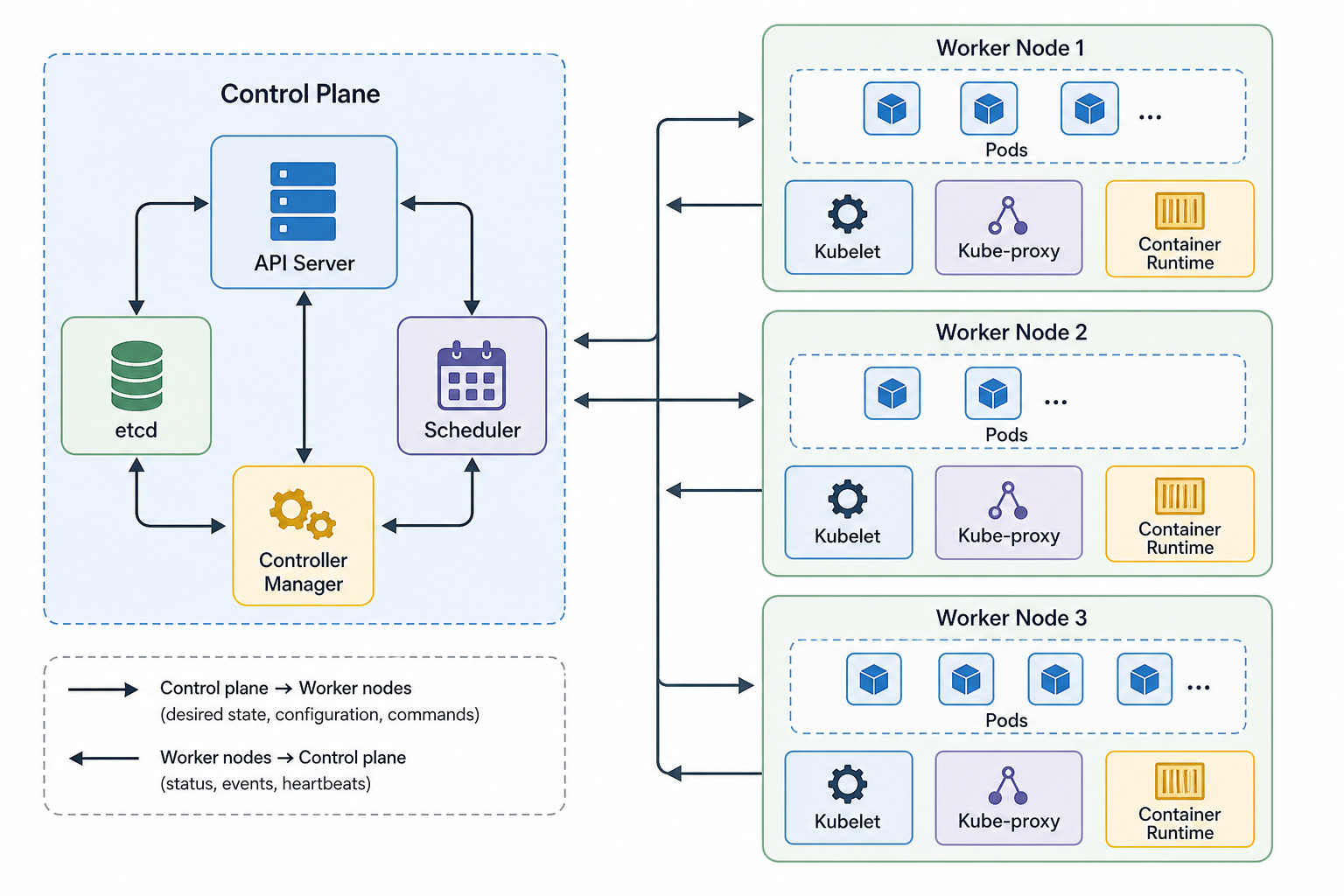
A Kubernetes cluster is built from two distinct layers: the control plane, which makes decisions about the cluster, and the worker nodes, which carry out those decisions by running your application workloads. Every cluster needs at least one worker node to run Pods, and in production the control plane itself typically spans multiple machines to provide fault tolerance and high availability.
This separation of concerns is deliberate. The control plane never runs your application containers directly. Instead, it continuously watches the state of the cluster and acts to bring reality in line with what you have declared. Understanding this division is the first step toward understanding why Kubernetes behaves the way it does when nodes fail, when load spikes, or when you roll out a new version of an application.
For a broader grounding in how software systems are structured, software architecture principles and patterns provide useful context.
The control plane: four components, one source of truth
The control plane hosts four core components, each with a precise responsibility.
The API server (kube-apiserver) is the front door to the entire cluster. Every request, whether it comes from kubectl, from a controller, or from a kubelet on a worker node, passes through the API server. It authenticates, authorises, and validates each request before writing the resulting object to storage. Critically, only the API server is permitted to write to etcd; no other component communicates with etcd directly.
etcd is a distributed key-value store and the sole stateful component in the control plane. Every object you create in the cluster, including Pods, Services, ConfigMaps, Secrets, and Deployments, is stored here. It is the single source of truth for the entire cluster.
kube-scheduler watches for Pods that have not yet been assigned to a node and selects a suitable node for each one based on resource availability and constraints.
kube-controller-manager runs a collection of controllers that continuously observe cluster state and act to reconcile it toward the desired state. The replication controller, the Deployment controller, the DaemonSet controller, and the node controller (which detects and responds to node failures) are all examples.
Worker nodes: where application containers actually run
Each worker node runs three components that together translate control plane decisions into running containers.
The kubelet is the primary node agent. It watches the API server for Pods scheduled to its node, instructs the container runtime to pull the required images and start the containers, monitors container health, and reports status back to the API server. The kubelet is the link between the control plane's intentions and the containers that actually run on the machine.
kube-proxy maintains network rules on the node that implement Kubernetes Services, allowing traffic to reach the correct Pods regardless of which node they are running on.
The container runtime is the software that actually runs containers. Kubernetes supports any runtime that implements the Container Runtime Interface (CRI), including containerd and CRI-O. Containerd is now the most widely used runtime; Docker was used originally but support was discontinued from Kubernetes v1.20 onward.
For a deeper look at how containers work before they reach Kubernetes, the complete guide to containerisation and Docker covers the fundamentals.
The API server as the cluster's communication hub
One of the most important architectural decisions in Kubernetes is that no component talks to another component directly. The scheduler does not talk to the kubelet. The controller manager does not talk to etcd. Every interaction flows through the API server.
This design keeps the system auditable, consistent, and secure. Every state change is a validated write to etcd via the API server, and every component that needs to react to a change watches the API server for updates rather than polling other components. The result is a loosely coupled system where components can be restarted or replaced without breaking the coordination model.
This is also why the API server is the first thing to diagnose when a cluster is behaving unexpectedly: if the API server is unavailable, the entire control loop stalls.
Declarative configuration and the reconciliation loop
Kubernetes does not ask you to start processes directly on servers. Instead, you describe the desired state of your system using resource definitions such as `Deployment`, `StatefulSet`, or `DaemonSet`. The control plane takes that declaration, decides where to place Pods, when to restart them, and how to react when nodes fail or capacity changes.
This ongoing loop between the control plane and the worker nodes is the architectural core of Kubernetes. Controllers continuously compare the current state of the cluster against the desired state stored in etcd, and take corrective action whenever the two diverge. A node that disappears, a Pod that crashes, or a Deployment that is scaled up all trigger the same mechanism: a controller notices the gap and acts.
This model maps well onto microservices architectures, where independent services need to be deployed, scaled, and recovered independently. Cloud management and optimisation practices build directly on this foundation.