Smaller boutique IT firms often outperform on complex, specialized projects

    Boutique IT Consulting Firms: Why Smaller Can Mean Better for Complex Projects

    Smaller boutique IT firms often outperform on complex, specialized projects

    How boutique IT consulting firms deliver deeper expertise and closer accountability than large generalist practices.

    Find the right consulting model for your project

    Explore how Techfirst's senior consultants handle complex IT projects from architecture through delivery.

    What makes a boutique IT consulting firm different

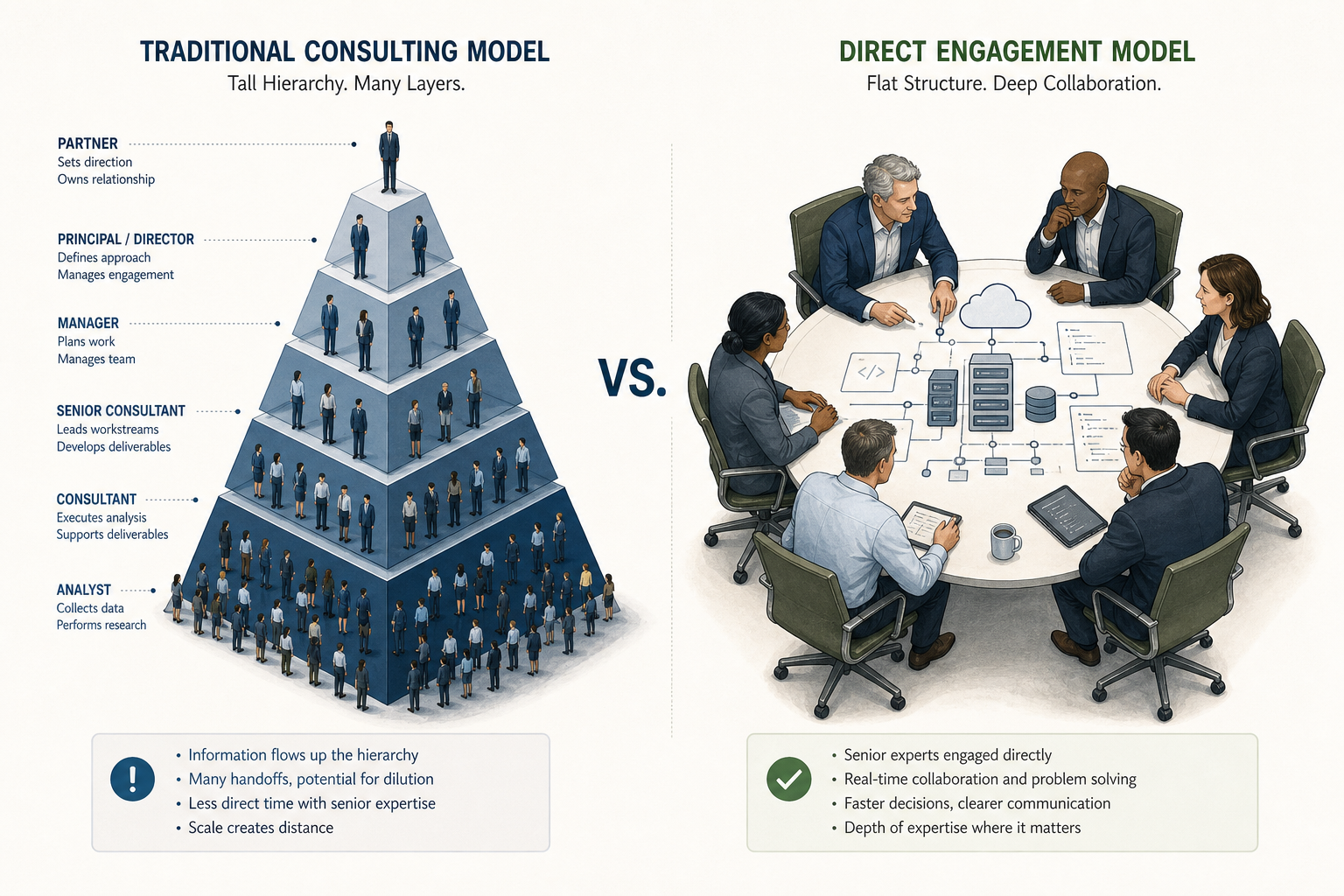
    Boutique IT consulting firms are small, specialized practices that focus on a defined set of technologies or industries rather than covering every IT discipline. A defining characteristic is that they operate with a small but elite team, where each consultant engages directly with clients and works toward resolving their specific challenges, rather than acting as one layer in a large delivery hierarchy. In practice, this means the people who scope the work are the same people who execute it. There is no separate sales team handing off to a junior delivery team after the contract is signed. For organizations with genuinely complex problems, such as legacy modernization, custom software architecture, or cloud migration, that continuity of expertise throughout the engagement is a meaningful operational difference, not just a style preference.

    The staffing model that separates boutiques from large firms

    Large global consultancies, including the well-known MBB group (McKinsey, BCG, Bain) and the Big Four, typically staff client engagements with a pyramid model: senior partners bring in the work and manage client relationships, while green MBA graduates or junior analysts carry out most of the day-to-day execution. Partners at large firms are usually occupied with finding new projects and client management, rather than working alongside the client team on the problem itself. Boutiques invert this. Senior practitioners with deep domain experience are the primary delivery model, not a supervisory layer above a pyramid of juniors. For a project that demands real architectural judgment, such as migrating a legacy integration layer to modern microservices or designing a Kubernetes-based cloud environment, the difference between a senior practitioner doing the work and a junior analyst following a template is significant.

    Agility and specialization as practical advantages

    Boutique consulting firms are quicker at adopting new procedures than large firms, because implementing change across a small, focused team is simply faster than cascading it through multiple management layers and global offices. This organizational agility matters most when a project's requirements shift mid-engagement, which is common in complex IT work. A boutique can adjust scope, timeline, and approach based on what the engagement actually needs rather than what the original proposal said months earlier. Specialization reinforces this: a good boutique does three to five things extremely well rather than fifty things adequately. In IT specifically, that focus tends to cluster around areas such as cloud computing, custom software development, cybersecurity, data analytics, or system integrations, making the firm's expertise genuinely deep rather than broadly distributed across a large headcount.

    Where large firms remain the stronger choice

    Large global consultancies earn their market position for a reason. Organizations that need simultaneous delivery across multiple geographies, very large programme management offices, or regulatory compliance across dozens of jurisdictions benefit from the scale, established frameworks, and global bench that only a large firm can provide. If the primary requirement is organizational change management at enterprise scale, or if the client needs a firm with brand recognition that satisfies internal governance committees, a large firm is genuinely the better fit. The honest comparison is not that boutiques are better overall; it is that the right choice depends on what the project actually demands. For a multinational rollout requiring hundreds of consultants across time zones, boutique capacity limits are a real constraint. For a focused technical engagement requiring deep expertise and close collaboration, those same large firms often cannot match what a specialized boutique delivers. You can find a structured overview of how to evaluate these tradeoffs in our guide to choosing the right IT consulting partner.

    Where Techfirst fits in this landscape

    Techfirst operates as a boutique IT consultancy in the Swedish market, with senior consultants covering cloud infrastructure, custom software development, system integrations, cybersecurity, and AI services. The technical stack centers on Microsoft and Azure ecosystems, including .NET, SQL, Kubernetes, Docker, and CI/CD pipelines, which means engagements stay within a well-defined area of genuine depth rather than being spread across every platform a client might ask about. Techfirst supplies both system architects and developers, making it capable of staffing and executing projects from greenfield environment builds through legacy modernization and microservices migrations. For organizations that need a senior-led team with direct accountability on technically complex projects, particularly those involving Azure cloud, AI integration, or custom .NET development, Techfirst's model is a close match to what boutique IT consulting is designed to deliver. For clients requiring global delivery capacity or very large programme teams, a larger firm is likely the more practical choice. Explore Techfirst's AI consulting services and cloud management offerings to see where the depth sits.

    Boutique IT firm vs. large global consultancy: who suits which project

    The right choice depends on what your project actually demands, not on which firm has the bigger brand.

    Large global consultancies (e.g. Big Four, MBB)
    Best suited to very large-scale enterprise programmes requiring simultaneous delivery across multiple geographies, large programme management offices, or regulatory compliance across many jurisdictions.Senior partners typically focus on client management; junior staff carry out most day-to-day execution.
    Techfirst (boutique IT consultancy)
    Best suited to technically complex, focused engagements where senior expertise and direct accountability matter more than headcount: cloud migration, legacy modernization, custom .NET or Azure development, AI integration.Senior consultants remain the primary delivery team throughout the engagement, not a supervisory layer above juniors.

    Choose a large global firm when your programme requires hundreds of consultants, global simultaneous delivery, or enterprise-scale change management. Choose Techfirst when your project demands deep technical expertise in Azure, cloud infrastructure, AI, or custom software, and you need senior practitioners doing the work, not overseeing it.

    The people who sell the work are the people who deliver the work, and for complex technical projects, that distinction changes everything.

    How to evaluate a boutique IT consulting firm

    1. 1

      Define what expertise density you need

      Start by mapping the technical complexity of your project. If the work requires genuine architectural judgment, such as designing a cloud infrastructure, migrating legacy integrations, or building custom software, the seniority of the people doing the work matters more than the size of the firm. Boutiques are best suited to projects where deep, focused expertise outweighs broad headcount. If your project is primarily about scale of delivery across many teams and geographies, assess whether a boutique's capacity can realistically meet that need.

    2. 2

      Verify who actually delivers the work

      Ask directly: who will be on-site or in the meetings, and what is their experience level? In large firms, the senior consultant who wins the engagement often hands off to a junior team. In a genuine boutique, the senior practitioners are the delivery team. Request to meet the people who will execute the project before signing, not just the partners who pitch it. This single check eliminates most of the risk of being understaffed with inexperienced consultants on a complex project.

    3. 3

      Assess specialization fit

      A boutique's value is directly tied to how well its specialization matches your problem. A firm that does three to five things extremely well is only the right choice if your project falls inside those three to five things. Check the firm's actual technical stack and delivery history against your requirements. For example, if your project involves Azure cloud migration, .NET development, or AI agent deployment, confirm the firm has senior practitioners with direct experience in those specific areas, not just general IT consulting credentials.

    4. 4

      Evaluate flexibility and accountability structures

      Complex IT projects rarely go exactly as planned. Scope shifts, unexpected integration constraints, and technology decisions that need revisiting mid-engagement are normal. A boutique's flatter structure means decisions can be made and implemented faster than in a large firm where changes require multiple approval layers. Ask how the firm handles scope changes, who has authority to make technical decisions, and how escalation works. Direct access to senior decision-makers throughout the engagement is a practical advantage, not just a selling point.

    5. 5

      Match the firm's capacity to your project's scale

      Be honest about scale requirements. Boutique firms, by definition, have a smaller bench than global consultancies. If your project requires simultaneous workstreams across multiple teams, or if you need a firm that can absorb significant scope expansion quickly, verify the boutique has the capacity before committing. For focused, technically complex engagements where expertise density matters more than headcount, boutiques are well-positioned. For large-scale enterprise programmes requiring hundreds of consultants, a larger firm is the more realistic choice.

    Benefits

    Senior practitioners do the actual work

    In boutique IT firms, the consultants who scope the engagement are the ones who execute it, rather than handing off to junior staff after the contract is signed. For complex projects, this continuity of expertise directly affects outcome quality.

    Deeper specialization in a defined area

    A boutique that does three to five things extremely well delivers genuinely deep expertise rather than broad coverage spread thinly across a large headcount. For technically demanding work, that depth is the primary value driver.

    Faster decisions without bureaucratic layers

    Flatter organizational structures mean scope changes, technical decisions, and escalations move faster in a boutique than through the approval layers of a large firm, which matters on projects where requirements evolve mid-engagement.

    Direct accountability throughout the engagement

    The principal or senior consultant remains the primary point of contact from kick-off through delivery. Direct access to decision-makers reduces the communication overhead and misalignment risk that comes with large firm hierarchies.

    Lower overhead without sacrificing expertise

    Boutique firms do not maintain large offices, marketing departments, or multiple management layers, which means lower overhead costs can be passed on without reducing the seniority or quality of the people doing the work.

    When boutique IT consulting is the right call

    Legacy system modernization with tight technical constraints

    A mid-sized manufacturer running on-premises infrastructure with aging integrations needs to migrate to Azure cloud without disrupting production operations. The project requires genuine architectural judgment: deciding which components to lift-and-shift, which to re-architect as microservices, and how to sequence the migration to avoid downtime. A boutique firm staffed by senior cloud architects is well-suited here because the complexity is technical rather than organizational, and the client needs direct access to experienced decision-makers, not a junior team following a migration template. Techfirst's combination of system architect staffing and cloud migration services covers exactly this kind of engagement.

    Custom AI integration into an existing business platform

    A healthcare provider wants to integrate AI-driven automation and real-time analytics into its existing digital platform without replacing the core system. The work involves understanding the existing architecture, identifying integration points, and building AI components that fit within operational and compliance constraints. This is precisely the type of project where senior-led boutique delivery outperforms a generalist large firm, because the problem requires deep, cross-disciplinary expertise in both the existing system and the new AI tooling. Techfirst's AI integration services and AI agent design capabilities are built for this kind of focused, technically demanding engagement.

    Greenfield cloud environment for a scaling business

    A growing retail business needs to build a cloud-native environment from scratch, including Kubernetes orchestration, CI/CD pipelines, and database infrastructure, to support a new digital platform. The project is technically complex but not large in headcount terms: it needs a small team of senior engineers who can make the right architectural decisions early, since those decisions will be expensive to reverse later. Getting the architecture right from the start is more valuable than having a large team execute a generic blueprint. A boutique with genuine depth in Azure, Kubernetes, and containerization is the right fit, and a large firm's overhead and staffing model adds cost without adding proportional value.

    A large-scale enterprise transformation requiring global delivery

    A multinational organization needs to roll out a new ERP system across dozens of countries, requiring simultaneous workstreams, a large programme management office, and consultants embedded in regional offices. This is a scenario where boutique capacity is a genuine constraint. The need for hundreds of consultants across time zones, established global delivery frameworks, and brand recognition that satisfies internal governance committees makes a large global firm the more practical and appropriate choice. A boutique, including Techfirst, is not the right answer here, and any honest evaluation of the options should say so plainly.

    Boutique IT consulting firms: common questions answered

    Complex IT projects deserve senior expertise, not junior execution

    If your project involves genuine technical complexity, such as cloud migration, legacy modernization, AI integration, or custom software architecture, the seniority and specialization of the people doing the work matters more than the size of the firm. Techfirst's senior consultants cover the full delivery cycle across Azure cloud, .NET development, Kubernetes, and AI services. Get in touch to discuss whether the engagement fits.