What generative AI development companies actually do
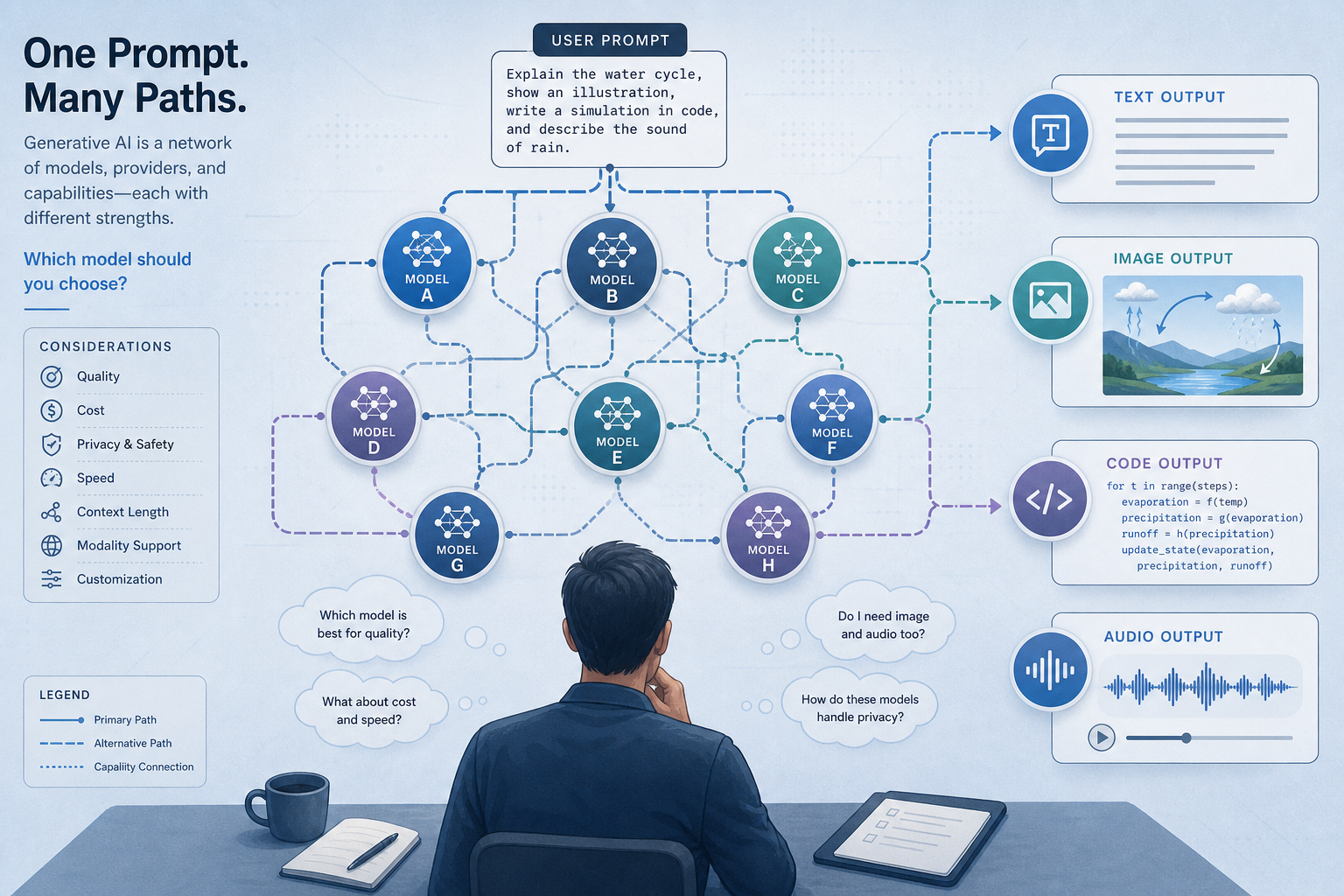
Generative AI development companies build systems capable of producing original content, including text, images, audio, code, and video, by training or adapting large models on substantial datasets. The market splits broadly into three types of provider. First, foundation model developers such as OpenAI, Anthropic, Google DeepMind, and Meta create the underlying AI from scratch. Second, consultancies and system integrators take those foundation models and fine-tune or customize them for specific industries or workflows. Third, end-to-end application builders use models like GPT or Gemini as a base and construct complete products on top. Understanding which type of provider you are actually evaluating is the most important first step, because each serves a fundamentally different need. Most enterprises do not need a new foundation model; they need the second or third type of provider, one that can connect capable AI to their existing infrastructure.
The foundation model giants and what they offer
The closed-source foundation model landscape is dominated by OpenAI, Anthropic, and Google DeepMind. OpenAI trained GPT-4 using 170 trillion parameters, and the computational power required for foundation modeling has doubled roughly every 3.4 months since 2012, which illustrates why building a foundation model from scratch is beyond the reach of most organizations. Anthropic's Claude models, including Claude 3.5 Sonnet, Opus, and Haiku, are designed for tasks such as automating workflows, moderating content, and accelerating research. On the open-source side, Meta, Stability AI, and Eleuther AI have made capable models publicly available. Amazon Bedrock aggregates many of these into a single API, offering access to models from Anthropic, Meta, Mistral AI, Cohere, and others. For most enterprise buyers, these are not companies to hire directly; they are the model providers whose outputs a development partner will build on top of.
Accenture and large global consultancies as a benchmark
At the top of the consulting market, Accenture is consistently ranked first globally for AI and generative AI consulting, with substantial generative AI bookings reported for fiscal year 2025. Firms at this scale offer deep industry practices, global delivery capacity, and the ability to run multi-year transformation programs across complex organizations. For a multinational enterprise that needs coordinated AI rollouts across dozens of business units, a firm like Accenture is a genuinely strong fit. The trade-off is that large consultancies are structured for large engagements. Smaller or mid-sized organizations often find that global firms route their work to junior teams, apply standardized frameworks that do not fit their specific stack, or require procurement processes that slow delivery. That gap is where more focused technical partners become relevant. If you are still evaluating what kind of partner to look for, the guide on how to choose an AI consulting company covers the key questions to ask.
Where Techfirst fits in this landscape
Techfirst is a Swedish IT consultancy whose generative AI development services are built around one practical goal: connecting capable AI to the systems a business already runs. Rather than offering a proprietary model or a platform subscription, Techfirst's senior consultants design and build custom generative AI solutions, AI agents, and conversational AI systems, then integrate them into existing enterprise infrastructure. The technical stack centers on Microsoft and Azure ecosystems, which means generative AI work sits alongside cloud migration, system integration, and legacy modernization rather than being treated as a separate project. For organizations on Azure, or those moving to it, this matters: AI that is designed alongside your cloud infrastructure from the start is far easier to secure, scale, and maintain than AI bolted on afterward. Techfirst also supplies both system architects and developers, so it can staff and execute projects rather than only advising on them.
Data privacy, security, and enterprise readiness
Enterprise generative AI deployments must address robustness, reliability, seamless integration with existing workflows, and security-centric design that protects sensitive data. Cohere, for example, has built its business specifically around large language models for enterprises that need flexible deployment options and control over proprietary data. That focus on data sovereignty is a legitimate differentiator for organizations in regulated industries. Techfirst approaches the same problem from the infrastructure side: because its consultants handle cloud architecture, CI/CD pipelines, and system integrations alongside AI development, security and data governance are built into the solution architecture rather than added as a layer. For businesses in healthcare, finance, or other sectors where data handling is non-negotiable, the ability to design AI and its surrounding infrastructure together, rather than separately, is a meaningful practical advantage. See also the related guide on choosing a cloud infrastructure provider for what to look for in a technical partner.