Legacy infrastructure is the real cost center
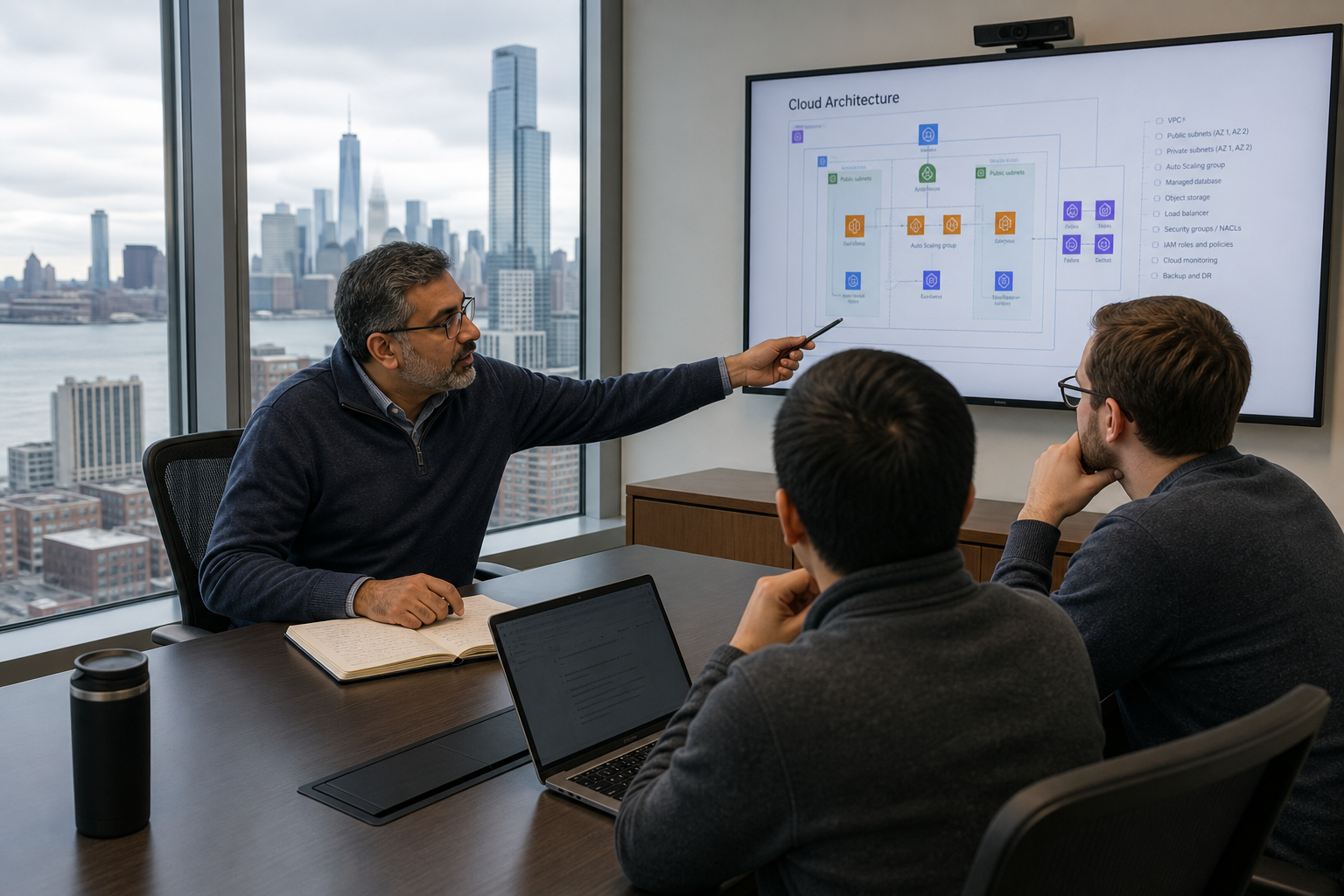
Most New Jersey organizations we talk to are not struggling because they lack ambition. They are struggling because their core systems, built over a decade or more of incremental decisions, have become expensive to maintain, difficult to extend, and impossible to integrate cleanly with modern tooling. The problem compounds in regulated sectors: a healthcare provider or financial services firm cannot simply swap out a platform. Every change carries risk, compliance implications, and operational continuity requirements. That is exactly the kind of landscape where a senior consultant earns their place, not by proposing a clean-slate rebuild, but by understanding what you have and designing a path that reduces risk at every step.
Embedded consultants move faster than advisory-only firms
There is a meaningful difference between a firm that assesses your situation and hands you a report, and one that stays in the room through implementation. TechFirst's consultants embed directly into client engagements, working alongside your internal teams as system architects and developers, not as observers. That means the people who design the solution are also the ones executing it, which eliminates the translation loss that typically happens when strategy and delivery are separated. Approximately 58 percent of global enterprises now engage IT consultants specifically for cloud migration, cybersecurity upgrades, and large-scale modernisation programs. The ones that see results tend to be the ones where the consultant is present through delivery, not just diagnosis.
New Jersey compliance demands local technical fluency
State-level regulations affecting healthcare, finance, and retail in New Jersey vary in ways that generic consulting playbooks do not account for. A cloud migration that is technically sound in the abstract can create compliance exposure if the architecture does not reflect the specific data residency, audit, and access control requirements that apply to your sector. TechFirst's engagements are grounded in the client's existing landscape, which means the assessment phase includes the regulatory context, not just the technical inventory. For organizations in sectors like healthcare IT consulting, that grounding is not optional. It is the difference between a migration that passes audit and one that creates new risk.
Cloud, software, and integration as a single engagement
Most modernisation programs touch all three layers: the infrastructure moving to cloud, the software that needs to be rebuilt or extended, and the integrations connecting internal and external systems. Treating these as separate workstreams, with separate vendors, creates coordination overhead and gaps that only show up in production. TechFirst covers all three within a single consulting engagement, drawing on senior architects for the infrastructure and integration design and developers for the custom software work. The core technical stack centers on Microsoft and Azure ecosystems, including .NET, SQL, Kubernetes, Docker, and CI/CD pipelines, which means the tooling choices are consistent across layers rather than stitched together from incompatible vendor preferences.
What a completed engagement actually delivers
The output of a TechFirst engagement is not a set of recommendations. It is a working system, migrated, rebuilt, or integrated, that your team can operate and extend. That might be an on-premises workload running on Azure with proper security boundaries and CI/CD automation in place. It might be a legacy monolith decomposed into microservices with clean API contracts. It might be an AI-driven automation layer introduced into an existing workflow. In each case, the engagement ends with something operational, not a slide deck. For New Jersey businesses operating in a market where technology employment pays nearly double the statewide average wage, the cost of a failed or stalled technology program is not abstract. Getting it done right, with senior people who stay through delivery, is the point.