Batch reporting is the wrong tool for live decisions
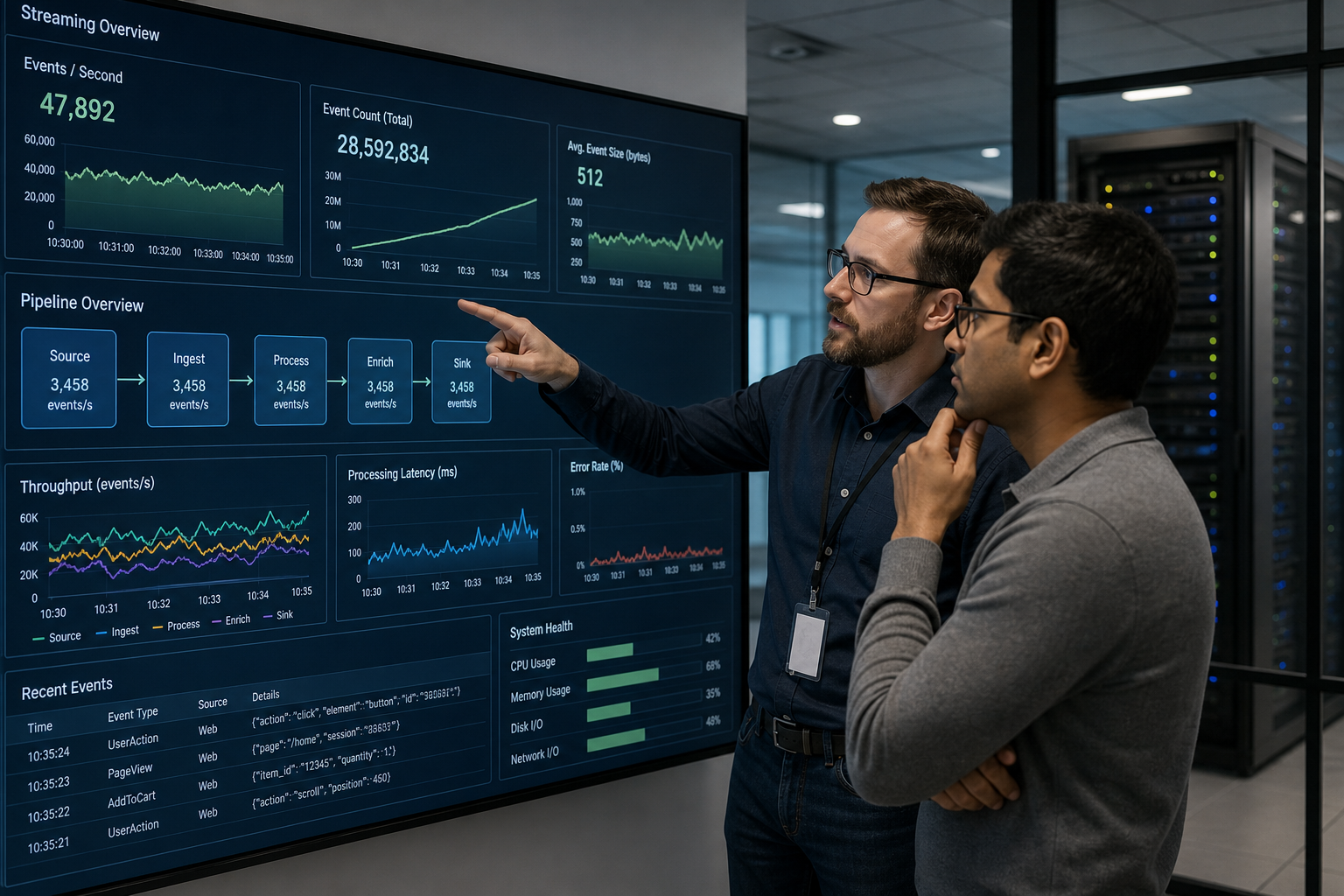
Most businesses still rely on reports that summarise what happened yesterday, or last hour. That gap between event and insight is where decisions get made on incomplete information. When your product prices shift, your inventory moves, or your users behave in ways that signal a problem, you need to know now, not at the next scheduled refresh. Streaming data pipelines change that relationship entirely. Instead of pulling snapshots, they process events continuously, so the analytics layer always reflects the current state of your system. TechFirst's consultants have built exactly this kind of capability, including real-time data processing improvements for a price comparison company where latency in data was a direct business liability.
Streaming pipelines built on infrastructure that scales
A real-time analytics capability is only as reliable as the infrastructure beneath it. TechFirst's core stack, centred on Azure, Kubernetes, Docker, and CI/CD pipelines, is designed for the kind of operational stability that streaming data demands. Events cannot queue up waiting for a server to recover. Kubernetes-orchestrated deployments mean the processing layer scales with load and recovers automatically from failures. This is not a bolt-on feature; it is an architectural decision made at the design stage. TechFirst supplies both system architects and developers, so the same team that designs the pipeline also implements it, without the handoff gaps that create inconsistencies between what was specified and what gets built. You can read more about the underlying development approach on our .NET development services page.
AI and analytics work better when they share the same data stream
Real-time analytics becomes significantly more powerful when it feeds directly into AI-driven automation. A streaming pipeline that surfaces anomalies can trigger an AI agent to act on them. A live data feed that tracks user behaviour can inform a generative AI system producing personalised outputs. TechFirst designs these layers to work together from the start, rather than connecting them as an afterthought. Our AI and automation services and AI agent design and development capabilities are built to integrate with the same modern infrastructure that underpins the analytics layer, so the two reinforce each other rather than creating new integration debt.
What this looks like across your existing systems
Real-time analytics does not require a greenfield rebuild. TechFirst's consultants are experienced in layering streaming capabilities onto existing systems, including legacy environments undergoing modernisation. The approach typically involves identifying the right event sources, designing the data model for continuous ingestion, and selecting the processing and storage components that fit the organisation's existing Azure footprint. For businesses already on a modernisation path, this work connects naturally to broader AI consulting services and integration projects. The outcome is a system where live data flows to the teams and tools that need it, without requiring a full platform replacement to get there.