The system that cannot scale is already costing you
Most enterprise IT budgets spend 60-80% on maintaining existing systems, which means the architecture that was good enough three years ago is now actively competing with new development for resources. That is before you count technical debt, which costs large organisations millions annually. The result is a familiar pattern: a critical project gets scoped, hits the existing system's limits, and stalls. Not because the idea is wrong, but because the foundation was never built to carry this load. Custom software development at enterprise scale starts by understanding that constraint, not by proposing a feature list.
Senior consultants who work inside the complexity
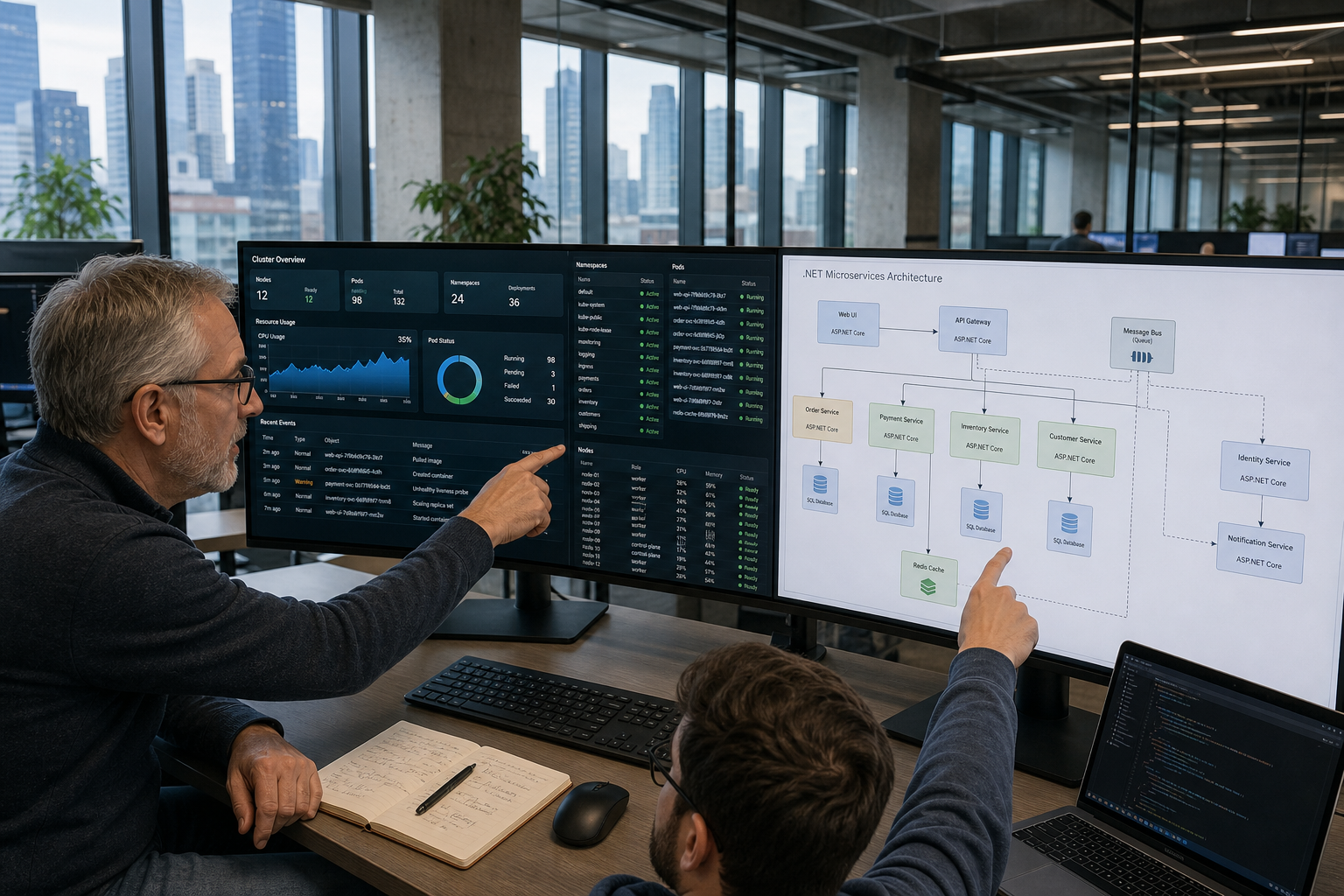
TechFirst delivers through senior consultants and developers embedded directly in client engagements. This matters because enterprise projects do not fail at the code level. They fail when the people writing the code do not understand the business constraints, the integration dependencies, or the operational environment they are building for. Our consultants cover the full delivery chain: system architecture, custom software development, cloud infrastructure on Azure, containerisation with Kubernetes and Docker, and CI/CD pipeline design. That means one engagement can take a project from architectural decision to production deployment without the handoff gaps that fragment most large builds.
Microservices and .NET are not optional at this scale
Enterprise .NET applications built for horizontal scaling require each service to scale independently, with built-in load balancing and a microservices architecture that isolates failure rather than propagating it. This is not a design preference at enterprise scale; it is the difference between a system that survives a traffic spike and one that takes your business offline. TechFirst's core stack, .NET, SQL, Azure, Kubernetes, and Docker, is specifically assembled for this operating environment. Blue-green and canary deployments via Kubernetes CI/CD give teams safer release cycles with immutable versioned artifacts, which reduces the risk surface every time new code ships.
AI integration belongs inside the architecture, not beside it
Generative AI development, AI agent design, and AI integration are part of TechFirst's delivery scope, not a separate offering bolted on afterward. For enterprise organisations, this distinction matters. An AI capability that sits outside your core platform creates a new integration problem rather than solving an existing one. When AI is designed into the architecture from the start, it can connect to real-time data, interact with existing business logic, and operate within the security and compliance boundaries the organisation already maintains. If you are evaluating what AI adoption actually looks like at your scale, our AI consulting services for enterprise covers that in more depth.
Modernisation has a measurable outcome, not just a roadmap
Enterprise modernisation projects that are structured and executed well produce concrete results. Infrastructure cost reductions of 25-35% and release cycles that run 40-60% faster are outcomes reported from completed projects of this type. Legacy modernisation surveys show 30-50% reductions in operational costs when the work is done with architectural discipline rather than incremental patching. TechFirst handles the full range: greenfield builds, legacy modernisation, microservices migrations, and cloud infrastructure moves from on-premises to Azure. The goal in every case is a system that costs less to run, deploys faster, and does not require your team to spend their days explaining its limitations to the business.