AI integration services that fit what you already run

    AI integration services

    AI integration services that fit what you already run

    Senior consultants embed AI automation, real-time analytics, and intelligent services directly into your existing infrastructure.

    Integrate AI into the systems you already depend on

    Talk to a senior consultant about where AI fits into your current architecture.

    Most AI projects fail at the integration layer

    Building a model or buying a platform is the easy part. The hard part is making AI work reliably inside the systems your business already depends on: your databases, your APIs, your cloud infrastructure, your deployment pipelines. That is where most projects stall. The AI component works in isolation but breaks down when it meets real production data, real latency constraints, and real organisational complexity. TechFirst's AI integration services are built around that exact challenge. Every engagement starts with understanding your existing technology landscape before a single line of integration code is written.

    Architecture design comes before deployment

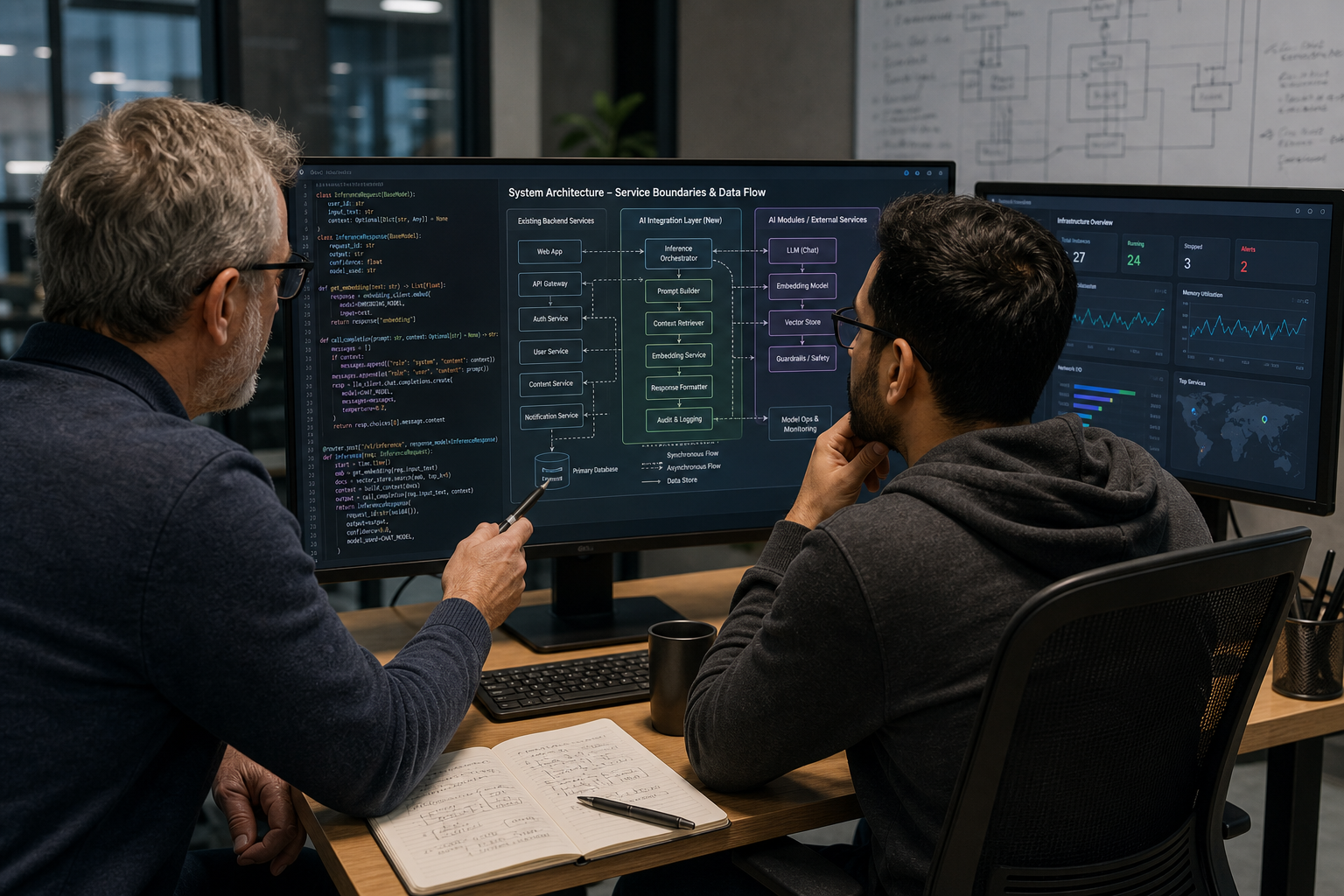
    Dropping an AI feature into a running system without an integration architecture is how you create technical debt that outlasts the project. TechFirst senior consultants design the integration layer first: how AI components connect to your data sources, how they communicate with existing services, and how they fit within your cloud infrastructure on Azure. That design work determines whether the resulting system is stable and scalable, or fragile and expensive to maintain. For teams also building CI/CD pipelines, that architecture feeds directly into automated deployment workflows so AI components ship with the same rigour as the rest of your software.

    Senior consultants lead every engagement

    Integration work is not a job for junior developers following a checklist. The decisions made during an AI integration engagement, about data contracts, latency boundaries, fallback behaviour, and security boundaries, have long-term consequences. TechFirst assigns senior consultants to lead each engagement. They bring the architectural judgement to make those decisions well, and the hands-on technical depth to execute them. The same people who design the integration build it. That continuity matters, especially for organisations whose existing systems span legacy components alongside modern microservices.

    What gets embedded and how it operates

    TechFirst integrates three categories of AI capability into client systems. Automation handles repeatable processes that currently require human intervention, reducing operational overhead without rebuilding the surrounding workflow. Real-time analytics surfaces intelligence from data that already exists in your infrastructure, making it actionable at the point of decision rather than in a report reviewed later. Intelligent services, including AI agents, add reasoning and adaptive behaviour to existing applications. All three are deployed as part of the full implementation lifecycle, from initial architecture through production deployment, not handed off as prototypes for your team to figure out.

    The AI component works in isolation but breaks down when it meets real production data, real latency constraints, and real organisational complexity.
    • Senior consultants lead every AI integration engagement from architecture through deployment.
    • Integration covers automation, real-time analytics, and intelligent services.
    • Architecture is designed around your existing technology landscape, not a generic blueprint.
    • Full implementation lifecycle: from design to stable, production-deployed AI components.
    • Azure and Microsoft ecosystem expertise underpins every integration engagement.

    How an AI integration engagement works

    1. 1

      Map your existing technology landscape

      The engagement begins with a structured review of your current systems: infrastructure, data flows, APIs, and any existing integrations. This is not a sales discovery call. It is the technical groundwork that determines what AI integration is actually feasible and where it will deliver the most operational value. The output is a clear picture of constraints and opportunities before any architecture decisions are made.

    2. 2

      Design the integration architecture

      Senior consultants design how AI components will connect to your existing systems. This covers data access patterns, service boundaries, latency requirements, and security considerations. The architecture is specific to your stack, not a generic blueprint adapted from a previous project. For Azure-based environments, this step also accounts for how the integration fits within your broader cloud infrastructure and deployment model.

    3. 3

      Build and embed the AI components

      The integration is built to the agreed architecture, with AI-driven features embedded directly into your existing services rather than bolted on as a separate layer. This includes automation logic, real-time analytics pipelines, or intelligent service components depending on the engagement scope. The same senior consultants who designed the architecture execute the build, so nothing is lost in handoff.

    4. 4

      Deploy through production-grade pipelines

      AI components are deployed using the same rigour applied to any production software. Where CI/CD pipelines are in place, the integration slots into existing workflows. Where they are not, TechFirst can establish them as part of the engagement. The goal is a deployed, operating system, not a proof of concept left for your team to productionise.

    5. 5

      Validate operational stability and fit

      After deployment, the integration is validated against real production conditions: actual data volumes, real latency, and live user behaviour. Any gaps between the designed architecture and production reality are resolved at this stage. The engagement closes when the AI components are operating stably within your existing infrastructure, not when the code is merged.

    Benefits

    Full lifecycle, not a prototype handoff

    TechFirst covers the complete implementation lifecycle from architecture design through production deployment. No prototype is handed off for your team to figure out how to ship.

    Senior consultants on every engagement

    Every AI integration engagement is led by senior consultants who make architectural decisions and execute the build. The same people who design the integration build it, so nothing is lost between design and delivery.

    Designed around your existing stack

    The integration architecture is built around your current infrastructure, APIs, and data flows, not a generic template. AI components fit your technology landscape rather than forcing changes to systems that already work.

    Three proven AI capability categories

    TechFirst integrates automation, real-time analytics, and intelligent services. Each is embedded into existing systems as a production-grade component, not a standalone tool running alongside your infrastructure.

    Who uses AI integration services

    Healthcare provider upgrading a legacy patient platform

    A healthcare organisation running a legacy digital platform needs to surface real-time analytics for clinical staff without replacing the core system. TechFirst designs an integration layer that connects AI-driven analytics to existing data sources, embedding intelligent reporting directly into the workflows clinical staff already use. The result is actionable intelligence at the point of care rather than in a separate reporting tool reviewed after the fact. For organisations also considering broader AI consulting services, this kind of engagement typically surfaces additional integration opportunities across the platform.

    Retail business automating operational workflows

    A retail or fashion business with manual processes across inventory, pricing, or fulfilment wants to introduce automation without rebuilding its backend systems. TechFirst integrates AI-driven automation into the existing operational infrastructure, targeting the specific workflows where human intervention is most costly. Because the integration is designed around the existing system rather than replacing it, the business avoids a full platform migration while still gaining meaningful operational efficiency.

    Automotive manufacturer adding intelligent services to a web platform

    An automotive manufacturer rebuilding its web platform with microservices needs AI-driven features, such as personalisation or intelligent search, embedded from the start rather than added later. TechFirst's senior consultants design the AI integration as part of the broader microservices architecture, ensuring AI components share the same service boundaries and deployment model as the rest of the platform. Teams working in parallel on AI development services can feed directly into this integration layer without duplicating infrastructure work.

    Event or price-comparison platform improving real-time data processing

    A price-comparison or event platform processing high volumes of real-time data needs AI-driven analytics embedded into its backend without introducing latency that degrades the user experience. TechFirst designs the integration with explicit latency boundaries, ensuring the analytics layer operates within the performance envelope the platform already maintains. Real-time intelligence becomes part of the product rather than a post-processing step that lags behind live data.

    Questions about AI integration services

    Start with your existing architecture, not a blank slate

    If your systems are ready for AI and you want an integration built to last, talk to a TechFirst senior consultant. We will start with your existing architecture and work from there.